

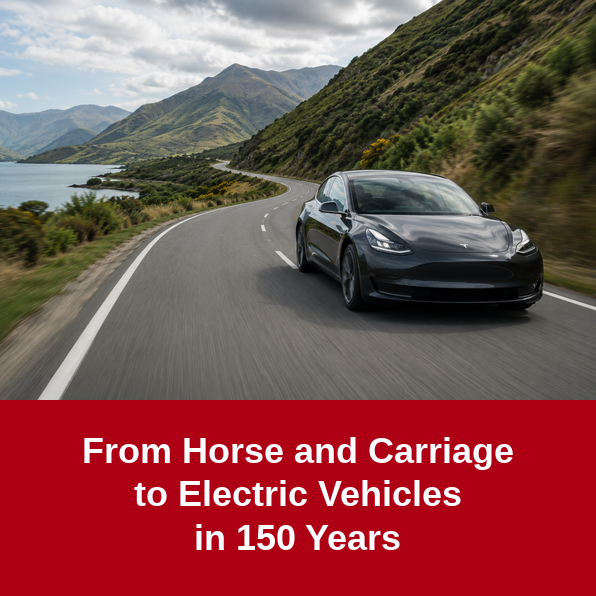
Driving in Australia and New Zealand never changed in a straight line. Vehicles, roads and our expectations of the people behind the wheel all evolved together, each one pushing the others forward. Look back across 150 years of transport history on both sides of the Tasman and one pattern keeps repeating: new technology only becomes safer when infrastructure and driver education keep pace with it.
Let’s take a practical walk through how driving evolved here. The vehicles look nothing like they once did, the roads have been transformed beyond recognition, and the tools available to drivers have improved enormously. Yet the part that matters most has never changed: real people, real roads, real risk, and the everyday choices that decide whether everyone gets home safe.
The Horse and Carriage Era
For most of the late 1800s, transport was slow, local and shaped far more by geography than by timetables. In Australia, cities like Melbourne ran on horsepower in the most literal sense, with tens of thousands of horses stabled across the city by the 1880s to keep goods, people and services moving. In New Zealand, rough unsealed roads were the norm, carved out track by track as settlements pushed inland from the coast. Te Ara, the Encyclopedia of New Zealand, records just how completely early colonial life depended on horse-drawn transport, from butchers’ carts and mail coaches to the omnibuses that carried city commuters.
Two safety realities defined the era. First, low speeds kept crash energy manageable, even when things went wrong on a wet bend or a steep descent. Second, shared space was simply how roads worked: pedestrians, animals, carts and riders all moved through the same corridors with little in the way of formal separation or signage.
Early Motoring Changes Everything
The motor car introduced a new kind of risk: speed, without the systems needed to manage it. Roads built for horses and carts were suddenly shared with machines that could travel far faster and stop far later than anything that had come before. The shift caught authorities and road users off guard, and it took decades to catch up.
Early cars brought a string of very real challenges. Higher speeds arrived on roads never designed for them, and stopping distances stretched far beyond what most people expected. Mechanical reliability was patchy, with lighting and braking that varied wildly between makes and models. A widening gap also opened between what vehicles could do and what drivers knew how to handle, and that gap proved stubbornly hard to close.
In both Australia and New Zealand, driving shifted rapidly from a niche pursuit to an everyday activity. More vehicles meant more interactions, more conflict points, and a much clearer need for road rules that ordinary people could understand and authorities could actually enforce.
When Infrastructure Catches Up
Over time, infrastructure began to do more than simply connect places. It started to shape behaviour and influence how people moved through their towns and cities. As road networks improved across both countries, the changes were gradual, but their cumulative effect was enormous.
Sealed surfaces and proper drainage made year-round travel far more reliable. Clearer intersections, signs and lane markings helped drivers anticipate what was coming next. Bridges and safer rail crossings removed some of the most dangerous flashpoints in the network. Urban planning also began to separate, or at least organise, different road users, so pedestrians, cyclists and vehicles were no longer competing for the same narrow strip of road. Organisations such as the NZ Transport Agency Waka Kotahi and Austroads carry that work forward today through ongoing research, design standards and safety programmes.
The trade-off still matters now. Better roads reduce certain risks while encouraging higher speeds and heavier traffic volumes. Safety depends on designing for both realities at once.
How Driver Education Grows with Risk
Learning to drive used to be entirely informal. People picked it up from family, from neighbours, or simply through time behind the wheel and a fair amount of trial and error. As traffic grew and vehicles became faster and more powerful, that approach stopped being good enough, and skill-building had to become far more consistent and structured.
Modern driver education builds hazard awareness so drivers spot risk early, along with sound decision-making under pressure. It covers the rules and responsibilities that protect everyone on the road, and it builds the wider culture needed for safety to become a shared effort rather than an individual one.
At SharpDrive, this is where history meets today’s practicality. When a workplace invests in driver training, the goal is not to tick a box for the regulator. It is to build repeatable habits that hold up on busy mornings, on long rural stretches, and at the end of a working day when fatigue starts to creep in.
From Petrol to Electric and Connected Vehicles
The last few decades have brought another major shift: vehicles started thinking with us, not just moving us from place to place. That change is being felt across Australia and New Zealand alike, where fleet operators and everyday drivers are navigating a fast-moving mix of new technology and transition.
Today’s fleet includes advanced driver assistance such as alerts, automatic emergency braking and lane support, alongside far better crash protection and visibility. Telematics and data now reveal trends in driving behaviour that were invisible to managers a generation ago, while a growing move to electric vehicles is being driven by efficiency, cost, policy and overall fleet strategy.
EVs reduce some mechanical demands while introducing new considerations for drivers and fleets. These include quieter operation around pedestrians, charging logistics on long routes, and instant torque that can catch new drivers off guard. Whatever the powertrain, safe outcomes still come back to awareness and the choices made behind the wheel.
For a look at how electric vehicles first appeared on this side of the world, DigitalNZ’s story Electric cars in New Zealand: the early years is a fascinating reference point. For a broader timeline covering the Australian market and where the technology is heading next, RACV’s The history and future of electric vehicles provides excellent context for fleet decision-makers.
What This History Means for You Today
The vehicles have changed enormously over 150 years. The responsibility behind the wheel has not changed at all. Here is a practical checklist to use with your team at work or your family at home:
- Plan the trip properly, factoring in time, route, rest breaks and weather before you leave.
- Drive to the conditions on the day, and remember that speed limits are not targets.
- Leave space between your vehicle and the one ahead; following distance buys you time for better decisions.
- Manage attention by keeping phones and screens out of reach, as they significantly reduce hazard detection.
- Expect the unexpected: people make mistakes, animals wander, and traffic stops suddenly without warning.
- Know your vehicle, whether EV or petrol, so its braking feel and acceleration response never surprise you.
- Build a learning culture where near-misses become lessons rather than secrets, by making it safe for people to speak up.
Across 150 years of transport history in Australia and New Zealand, the pattern is remarkably consistent. Progress is not just about new technology arriving in showrooms. It is about roads built for humans, rules built for fairness, and training built for real life on real roads.
At SharpDrive, we help businesses turn that understanding into practical driver safety programmes that work across vehicles, roles and regions. To build a training programme that sticks, get in touch with SharpDrive and learn how we support safer workplaces.


